
With the last quarter of 2023-24 (FY24) expected to have been soft owing to lower discretionary spend and macro uncertainty, many are hoping FY25 will be a year of recovery for the information-technology (IT) industry. The fourth quarter, January-March, is considered soft, and will continue to see the headwinds the sector has been facing. And the sector has entered the new financial year on a weak footing. Analysts are expecting Tier-I firms to report sequential growth of -1 per cent to 1.5 per cent and midcap players' growth may range between 0.7 per cent and 4 per cent.

"On space, we will be able to announce that India is signing the Artemis Accords, which advance a common vision for space exploration for the benefit of all humankind," a senior administration official said hours before the meeting between Prime Minister Narendra Modi and President Joe Biden in the Oval Office.

'Like every Budget, this time, too, there is chatter around tinkering with the long-term capital gains tax.' 'Investors may not want to jump into the markets until there is clarity on this front.'

'Chinese are going bang, bang, bang building 30-35 reactors.' 'We should announce a programme of 50 new reactors and show that we mean business on the ground and not just announcements.'

'Democracy cannot be taken for granted. It has to be fiercely guarded.'

Among the Sensex firms, Maruti, NTPC, Tata Motors, ICICI Bank, HDFC Bank, Reliance Industries, JSW Steel, ITC and Mahindra & Mahindra were the major laggards. Bajaj Finance, Larsen & Toubro, Bajaj Finserv and Titan were among the gainers.

Indian start-ups breathed a sigh of relief after the UK government facilitated the acquisition of the now-defunct Silicon Valley Bank's (SVB's) British arm by HSBC. In a bid to allay fears, the US Federal Deposit Insurance Corporation (FIDC) announced recently that it had transferred all deposits of start-up-focused SVB to a newly created bridge bank and all depositors would have access to their money. President Joe Biden also sought to reassure jittery depositors that they can have confidence that the US banking system is "safe".

No government in the past initiated the process of policy making for its next tenure even before going in for elections. Once the Model Code of Conduct is enforced by the Election Commission, should the government of the day refrain from taking an active interest in policy making for the next five years and let that be the function of the new government?, asks A K Bhattacharya.

'We have essentially tried to set out an agenda for the next five years and it, in essence, represents the political commitment to that agenda.'
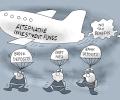
Alternative investment funds (AIFs) have not seen any significant redemptions from financial institutions even though the 30-day timeline provided by the Reserve Bank of India (RBI) to liquidate their holdings or make full provisions ends recently. Sources said the industry is awaiting certain relaxations or extensions based on the recommendations submitted to the banking regulator. On December 19, the RBI restricted financial institutions and banks from investing in AIFs where there is any downstream link or exposure to a debtor firm.

In his letter to Sitharaman, Venugopal said media reports have exposed the alleged "quid-pro-quo between BJP and several firms, which in a strange coincidence donated to it, after the Enforcement Directorate (ED), Income Tax Department (IT) and Central Bureau of Investigation (CBI) and others, raided or searched those enterprises".

Indian society may be more advanced than we think it is, notes Ajit Balakrishnan.

'Limited spillovers' to Asia's third-largest economy, even as world 'perilously close' to recession.

The Paris-headquartered FATF said Pakistan should continue to work on implementing its action plan to address its strategic deficiencies

Severe skilled, unskilled shortage threatens to pull emergency brakes on India's industrial engine.

From the Sensex basket, Tata Consultancy Services, Nestle, Bajaj Finserv, Wipro, Maruti Suzuki India, Reliance Industries, Larsen & Toubro and NTPC were the major laggards. Tata Steel, Bajaj Finance, JSW Steel and Bharti Airtel were among the gainers.

'No Budget has so far has addressed the issue of the government's abysmal productivity of capital spending, improving which will be the big game changer. 'But, the government's tight lock on businesses, banks, education, and even essential services like transportation and large parts of infrastructure and healthcare is destroying capital year after year,' points out Debashis Basu.

India's role as a leader of the global south may require it to give up its ambition to serve as a bridge between the warring halves of the international community, points out Mihir S Sharma.

Indian FIs are fast getting their act together to counter stiff competition from the banking entities.

The home loan top-up, a kind of secured multipurpose personal loan, is on the regulator's radar, points out Tamal Bandyopadhyay.
Citigroup India on Thursday announced a $3.5 million grant to the Indian School of Micro Finance to be set up in Ahmedabad.

Shares of public sector enterprises have corrected by up to 22 per cent month-to-date until March 19, 2024. Analysts attribute this steep fall to the valuation exuberance seen after a sharp run in these counters last year and suggest investors remain selective regarding the stocks in this space. "The rally in public sector undertaking (PSU) stocks has been stretched and sharp, although it is somewhat justified by improvements seen in earnings, operations, balance sheets, and overall profitability.

As the Narendra Modi government nears completing a year in office, the Congress on Wednesday stepped up its offensive against the prime minister accusing him of weakening democracy by running a "one-man show" while scoring maximum on "arrogance" and minimum on governance.
Notwithstanding the recent sharp decline in the stocks of public sector companies, analysts at Jefferies remain bullish on this segment. State Bank of India, Coal India, and NTPC are their top picks in this space, they said in a recent note. The public sector undertaking (PSU) or state-owned enterprise (SOE) index, with a 70-percentage-point outperformance versus the National Stock Exchange Nifty50 over the past 12 months, comes after a decade of underperformance before 2020.

India's unabated tryst with Russian crude oil is slowly coming to an end. The time has come for Indian refiners to navigate, creatively, the choppy waters of the post-honeymoon period, and for Indian policymakers to take cognisance of the broader impact on India from the spillover of the Russian crisis - after Washington's warning to transgressors last week. Shipments from Russia to India have averaged over 1.8 million barrels a day since February, according to data from Paris-based market analytics firm Kpler. But much of the crude shipped to India was non-sanctioned because it traded below a price cap set by the US led G-7 nations in December.

'Somebody was using somebody to make statements that will stir the stock market and lead to a surge.' 'A sudden surge and a sudden crash is always an ideal situation for people to make illicit gains and then siphoning off the money.'

The institute has bagged 179 pre-placement offers so far, with the highest domestic offer at Rs 64 lakh per annum.

'I found it unbelievable that L&T said 45,000 jobs were waiting to be filled because of unavailability of suitable skillsets.' 'So, when the Opposition sweepingly says there are no jobs, I'm sorry... I'm not saying it's raining jobs, but there are jobs. The (skill) gap has to be bridged.'

The government has identified nine key focus areas in the AI national programme, including agriculture, education, Indian languages, smart cities, cybersecurity, transportation, and finance.

'Das is friendly, but he finally does what he does. The quality of engagement is very good.'
What does Arun Jaitley's Union Budget have for India's student population? We explore
GE Commercial Finance, which has an asset base of more than $230 billion globally, is planning to increase its exposure in the Indian market.

New Delhi was reluctant to spook investors by clipping the bank's wings
Dubbing as 'manufactured crisis,' the sharpest fall of the Sensex, Finance Minister P Chidambaram sought to woo back FIIs, saying no FII has been assessed as a trader for tax purposes.

'We are receiving a steady stream of interest from well-established foreign universities.'

Banks, the biggest component of the Indian equity market, are now trading at a big discount to the benchmark indicesThe BSE Bankex index, which tracks the share price of the 10 top listed banks, is trading at a trailing price to earnings (P/E) multiple of 15.3X, nearly a 40 per cent discount to the BSE Sensex current P/E of 24.37X. This is the biggest valuation gap between the two indices in at least 10 years. Similarly, the BSE Bankex price to book ratio (P/B) of 2.22X is 40 per cent lower than the current Sensex P/B ratio of 3.61X.

Coming Wednesday, Finance Minister (FM) Nirmala Sitharaman will present the 2023 Union Budget - the last full Budget ahead of the 2024 Lok Sabha elections. While India exited 2022 as a relatively bright spot in the global economy, the FM will endeavour to present a Budget that insulates India's economy against global headwinds and recession in advanced economies, while sticking to the path of fiscal consolidation. In this, she is being helped by her core team of trusted advisors.

The committee will submit its report in two months and its chairperson can invite any expert of any institution in the country to help in the probe into the April 10 tragedy, a notification by Jharkhand tourism department said.

Hena Mehta will answer Your Questions on personal finance on a weekly basis. Please mail your questions to getahead@rediff.co.in with the subject line 'Personal Finance Query' along with your name and Hena will offer his helpful advice.
The current sub-prime crisis, in the medium-to-long term period, will accelerate global sourcing adoption as financial institutions are exercising the option to cut costs. The institute predicts that outsourcing from the financial services sector have the potential to increase 40-45 times the current market size over the next five years, with key drivers of growth coming from cost pressures and the timely advent of more vertical-specific offerings by offshore suppliers.
